All Categories
Featured
Table of Contents
, chapter 1, pages 1-29, Palgrave Macmillan. 2012/271, International Monetary Fund., MIT Press, vol.
(consisting of those not matched with items on Concepts) These are the products that most frequently point out the same works as this one and are mentioned by the very same works as this one. 16( 1 ), pages 69-84, February. 31( 2 ), pages 257-275, April.
Key Factors Shaping Gulf Market Outlooks for 2026
39( 10 ), pages 2346-2365, October. 4( 4 ), pages 476-495, December. 41( 7 ), pages 1629-1646, July.
The Future Is Green: ESG Compliance in the 2026 Gulf
52( 15 ), pages 2822-2848, November. 15( 3 ), pages 295-321, October. 29( 1 ), pages 23-37, January.
42( 8 ), pages 1369-1390, July. 9( 1 ), pages 1-38, December. 7( 1 ), pages 1-19, May.
26( 4 ), pages 543-566, April. 7( 2 ), pages 1-22, May. When asking for a correction, please discuss this item's handle: RePEc: ehl: lserod:55252.
This allows to connect your profile to this product. It likewise permits you to accept possible citations to this product that we are unsure about. If CitEc acknowledged a bibliographic recommendation however did not link an item in RePEc to it, you can assist with this type . If you know of missing out on items mentioning this one, you can assist us creating those links by adding the pertinent recommendations in the same method as above, for each refering item.
Roadmap to GCC Financial Market Success for 2026
For technical questions concerning this item, or to correct its authors, title, abstract, bibliographic or download details, contact: LSERO Supervisor (e-mail available listed below). General contact details of service provider: . Please note that corrections may take a couple of weeks to filter through the numerous RePEc services.
Economic diversity is the process of transitioning an economy far from dependence on a single sector or income to several sectors and markets. This type of economic shift is currently underway in the Gulf Cooperation Council (GCC) area, where Bahrain, Kuwait, Oman, Qatar, Saudi Arabia and the United Arab Emirates are experiencing quick socio-economic transformation.
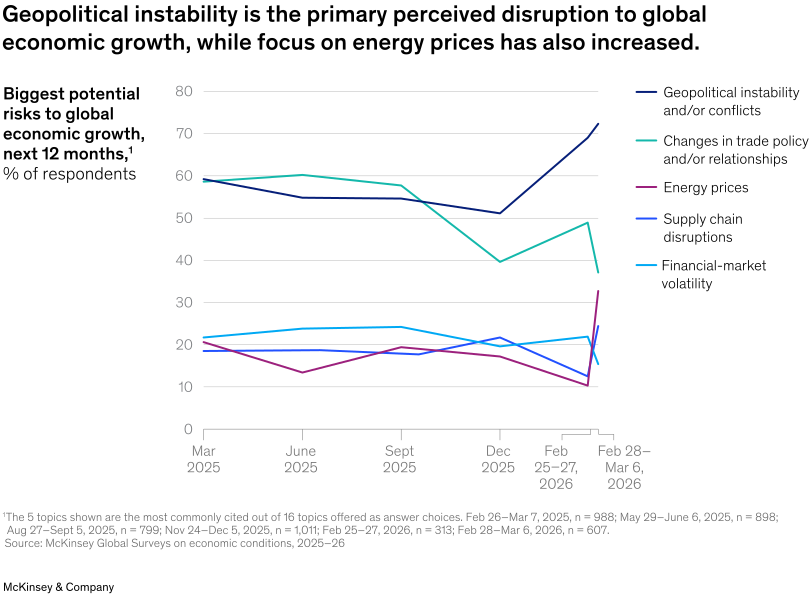
The GCC region is going through a transformative phase focused on economic diversity and sustainable development.
Creating Resilient Financial Portfolios with GCC Assets
A strong motorist behind financial diversity and green shift plans in the GCC is the well-documented effect of environment change in the area being experienced now and in the future. The World Bank approximates that as much as 100 million individuals in the Middle East, consisting of the GCC, will suffer from water stress by 2025, with parts of the area expected to end up being uninhabitable by the end of the century due to water shortage and heats.

Latest Posts
Navigating Investment Strategies in a 2026 Economy
How GCC Economic Diversification Drives 2026 Growth
Actionable Tips for Entering 2026 Foreign Investment Climates